
I started a series on JavaScript solutions to common algorithms and javascript problems. In case you missed the first one, here's a link to it. Ear...

For further actions, you may consider blocking this person and/or reporting abuse


It's Python (so, off-topic), but I couldn't help myself:
O(n), if you're wondering.
Flawed, would fail for strings like ('aabb', 'aaab')
Good catch. I'd overlooked that edge case. Let me ponder....
AHA! The most obvious solution is...
sorted()employs Timsort, which has a worst case ofO(n log n). Everything else is still onlyO(n).Naturally, I'm sure there's a more efficient solution if I chew on this longer, but that'd be the one I'd probably use in production; reasonable performance, readable, maintainable, etc.
EVEN BETTER! I just thought of a completely
O(n)solution that relies on the commutative property of addition, and the fact that any letter would have a unique numeric equivalent (retrieved viaord()).Ahhh, I love a good hack.
Nope, this is flawed too. There are multiple ways to express a sum. 3+2=5 and 4+1=5 as well.
So ord('a') + ord('z') = ord('b') + ord('y')
Would fail for strings such as ('az', 'by').
Hmm, hadn't considered that angle....
What do you think?
Copyright (c) 2019 Caleb Pitan
😇😁😁
I think that function expressions using ! are there just to make the code less readable.
My bad! I won't lie to you I really don't know the use of the "!", but I think it's to indicate an
iifeinside the function, hence aid readability. I put it because in my early years I saw a lot of these around, and I thought having it around or not affects nothing. Didn't know it affects readability, although I don't understand how. I wouldn't mind if you told me.I prefer explicit to implicit (comes from enjoying Python too much...) and
!(function(){...}();is just... well, if you haven't seen it before you have no idea what the gosh darnit is going on.digitalfortress.tech/js/exclamatio...
I initially thought about that approach, but discarded it for an obvious reason:
Solution 1 might not be completely correct if you don't check that the length of s and t are the same otherwise return false like so:
Otherwise this test will return true even though it should be false
My first solution (ES2019) looks like this:
Here's an O(∞) solution inspired by bogosort. If it halts,
aandbare anagrams.My intuition, before i saw any of the solutions, went into the 2nd one because it feels like it would be the easiest to understand and the fastest. I wonder if thats the case ;)
Thank you for the brain teaser, good beginning of the day :)
In order to remove spaces, you are calling string.replace once for every occurrence of " " (space) in each string. An easier way to remove whitespace in a string is to use a regular expression object with a global modifier, which will replace all matching characters in the string. Then, you can get rid of your while-loops, and your code becomes slightly easier to read. I hope it will help you to complete your Anagram checker project .
You can also use the /\s/g regular expression object to replace all whitespace including tabs, newlines, etc.
const same = (s1, s2) => { const str1 = s1.toLowerCase(); const str2 = s2.toLowerCase(); if (str1 === str2) return true; if (str1.length !== str2.length) return false; const obj1 = {}; const obj2 = {}; str1.split('').forEach((s, i) => { obj1[str1[i]] = (obj1[str1[i]] || 0) + 1; obj2[str2[i]] = (obj2[str2[i]] || 0) + 1; }); const arr1 = Object.entries(obj1).map(String).sort().toString(); const arr2 = Object.entries(obj2).map(String).sort().toString(); return arr1 === arr2; }; same('textwisttime', 'timewisttext');This is a favorite interview question of mine. The character map solution is what most people seem to do - myself included!
Great article Sarah! Mind sharing any resources for leveling up on Data Structures and Algorithms. Thanks
I'm taking a course by Stephen Grider on Udemy. Another recommended course is by Colt Steele - JavaScript Algorithms and Data Structures Masterclass.
tried all the above and the below solutions but the least execution time was taken by this one.
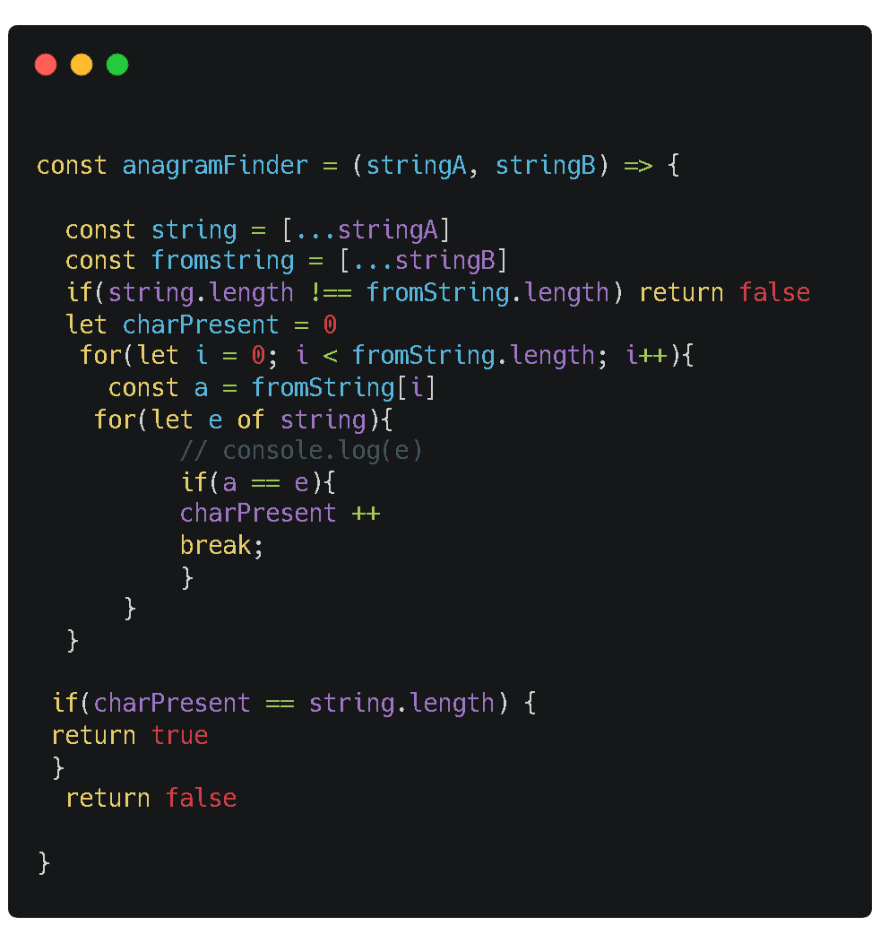
Solution 2 is not correct. What if I pass a word with extra letters to string 2???
For example?