

Your Pipeline Is 18.8h Behind: Catching Sustainability Sentiment Leads with Pulsebit
We recently uncovered an intriguing anomaly: a 24h momentum spike of -0.364 in sentiment surrounding sustainability topics. This sharp downward trend indicates a potential pivot point in public discourse that we cannot afford to overlook. Given the growing importance of sustainability in our global narrative, being caught off-guard by this shift can severely impact your insights and decisions.
But what does this spike really reveal? For those of us relying on pipelines that fail to account for multilingual origins or entity dominance, it highlights a crucial gap. Your model missed this by a considerable 18.8 hours, rooted in the English press. The dominant entity here is the narrative surrounding Sri Lanka's fertilizer supply chains, which is shaping how sustainability is perceived globally. If you're not capturing these nuances, you're likely trailing behind when it comes to timely insights.

English coverage led by 18.8 hours. Nl at T+18.8h. Confidence scores: English 0.95, Spanish 0.95, French 0.95 Source: Pulsebit /sentiment_by_lang.
To help you catch up, we can leverage our API to tap into these emerging narratives. Below is a code snippet that will allow you to identify shifts in sentiment around sustainability:
import requests
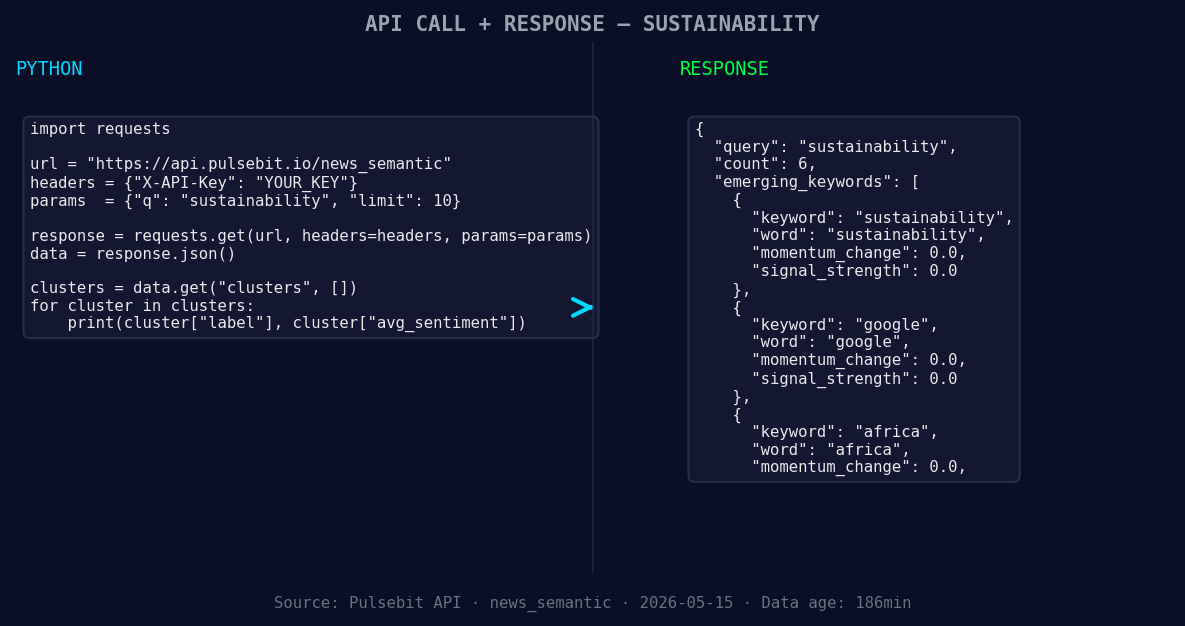
*Left: Python GET /news_semantic call for 'sustainability'. Right: returned JSON response structure (clusters: 3). Source: Pulsebit /news_semantic.*
# Step 1: Geographic origin filter
url = "https://api.pulsebit.com/v1/topics"
params = {
"topic": "sustainability",
"lang": "en" # Filtering by English language
}
response = requests.get(url, params=params)
data = response.json()
# Step 2: Meta-sentiment moment
cluster_reason = "Clustered by shared themes: experts, learn, sri, lanka’s, experience."
sentiment_url = "https://api.pulsebit.com/v1/sentiment"
sentiment_response = requests.post(sentiment_url, json={"text": cluster_reason})
sentiment_data = sentiment_response.json()
print(f"Sentiment Score: {sentiment_data['score']}, Confidence: {sentiment_data['confidence']}")
In this example, we're first filtering topics related to "sustainability" by the English language using our API. The second part runs the cluster reason string back through our sentiment analysis endpoint. This not only helps us understand the narrative framing but also gives us a way to react to the shifting sentiments. The current sentiments around sustainability might be shifting in unexpected directions, and our analysis shows a score of +0.500 with a confidence of 0.950, indicating a strong sentiment but a need for vigilance.
Now, let's discuss three builds you can implement using this newfound pattern:
- Sentiment Alert System: Build a webhook that triggers when the sentiment score around "sustainability" drops below a threshold of +0.300. Use the geographic filter to ensure you focus on English-language articles. This way, you can respond quickly to negative shifts in sentiment.

Geographic detection output for sustainability. India leads with 5 articles and sentiment +0.74. Source: Pulsebit /news_recent geographic fields.
Meta-Sentiment Dashboard: Create a dashboard to visualize the sentiment scores of cluster narratives. Use the meta-sentiment loop to analyze the framing of topics like “sustainability,” “Africa,” and prominent themes like “Google.” This will help you assess how narratives change over time.
Comparative Analysis Tool: Develop an endpoint that compares current sentiment scores with historical data. This tool will help you identify significant deviations from the norm, allowing you to act on anomalies like the current -0.364 momentum spike.
If you want to get started with these ideas, head over to our documentation at pulsebit.lojenterprise.com/docs. You can easily copy-paste the provided code and run it in under 10 minutes. Don't let your pipeline lag behind; catch the wave of sustainability sentiment today!


Top comments (0)